How Digital Forensic Labs Should Compare Modern Digital Forensics Software
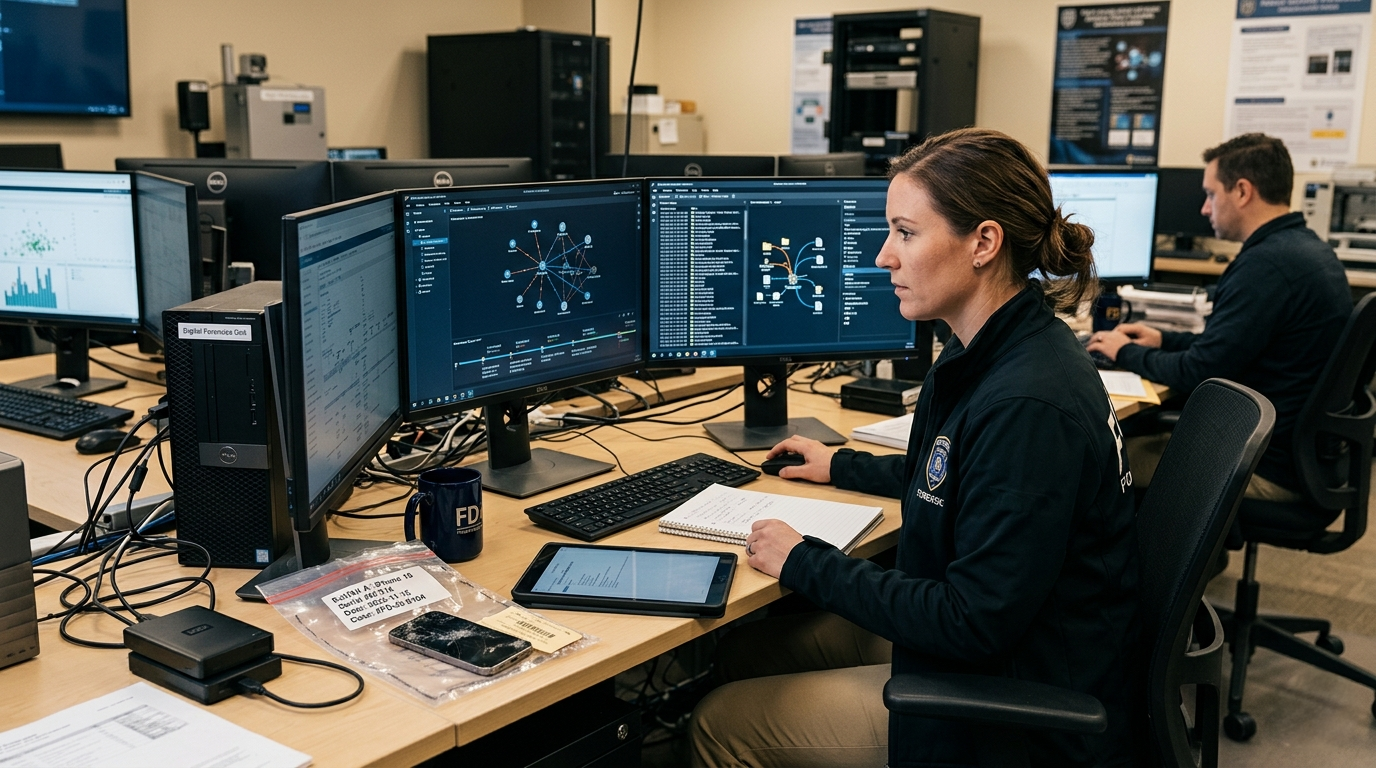
Choosing digital forensics software today requires far more than comparing feature lists. Modern investigations involve computers, mobile devices, cloud services, encrypted containers, volatile memory, SaaS platforms, collaboration applications, and increasingly massive evidence volumes.

Digital forensic labs should evaluate software platforms using a structured, evidence-driven methodology focused on forensic soundness, validation, reproducibility, workflow efficiency, scalability, and courtroom defensibility.
Platforms such as Belkasoft X are increasingly evaluated not only for artifact extraction capabilities, but also for how effectively they support the entire DFIR workflow—from acquisition and analysis to reporting and testimony preparation.
Why Feature Lists Are Not Enough
Many digital forensic software purchasing decisions still rely too heavily on:
- Vendor reputation
- Marketing claims
- Number of supported artifacts
- AI buzzwords
- “All-in-one” platform promises
However, digital forensic investigations are not won by the longest feature list. The best digital forensic software is the platform that produces the most reliable, reproducible, and defensible results for the lab’s actual investigative workload.
1. Start With Mission and Case Profile
A forensic lab’s mission profile defines the scope of evidence types, case complexity, and investigative priorities it must support. This is the foundation for all subsequent tool comparisons, because no forensic platform performs equally well across all domains.
Understanding the case profile helps ensure that tool selection is driven by operational reality rather than generic capability lists. For example, a lab focused on mobile device investigations will require very different coverage compared to a unit primarily handling incident response or cloud forensics.
Before comparing forensic tools, labs should define their real-world case mix:
- Computer forensics
- Mobile device forensics
- Cloud investigations
- Incident response
- Memory forensics
- Malware analysis
- Media exploitation
- Cryptocurrency tracing
- Triage vs full examinations
For example, Belkasoft X is frequently evaluated for its ability to correlate evidence across computers, mobile devices, cloud sources, memory images, and communication artifacts within a unified investigative workflow.
2. Compare Full Investigative Workflows
A forensic workflow describes the end-to-end process of handling digital evidence, from acquisition through reporting. Evaluating software at the workflow level ensures that no critical investigative stage is overlooked.
Instead of assessing isolated features, labs should verify how smoothly a platform supports transitions between stages such as acquisition, parsing, analysis, correlation, and reporting, since weaknesses in any single stage can compromise the entire case.
Digital forensic software should be compared across the complete evidence lifecycle:
- Evidence acquisition
- Hash verification and preservation
- Artifact parsing and extraction
- Deleted data recovery
- Timeline analysis
- Cross-source evidence correlation
- Search and filtering
- Reporting and review
- Audit logging
- Courtroom defensibility
3. Evaluate Technical Coverage
Technical coverage refers to the range of digital evidence sources a forensic platform can properly acquire and analyze. This includes operating systems, file systems, applications, cloud services, and device types.
Incomplete coverage can lead to missed artifacts or partial reconstructions of events, which directly affects investigative accuracy. Labs should prioritize coverage aligned with real-world case data rather than theoretical or rarely encountered sources.
Modern forensic labs should compare:
- Operating system support
- File system coverage
- Mobile OS and app support
- Cloud and SaaS artifact parsing
- Encrypted data handling
- VM and container analysis
- Memory acquisition and analysis
- Browser and messaging artifacts
- Remote collection capabilities
Labs should validate capabilities against current evidence sources encountered in real investigations—not only vendor datasheets.
4. Validate Forensic Soundness
Forensic soundness ensures that digital evidence is collected, processed, and analyzed without altering its meaning or compromising integrity. It is a core requirement for any tool used in legal or investigative contexts.
This includes maintaining hash integrity, preserving metadata, ensuring reproducibility, and providing transparent processing methods that can be independently verified by another examiner or organization.
Forensic validity remains one of the most important evaluation criteria.
- Bit-for-bit acquisition support
- Automatic hashing and verification
- Audit trail logging
- Reproducibility of results
- Reliable metadata preservation
- Transparent parsing methodologies
- Validation documentation
Belkasoft tools have undergone numerous validations within the NIST Computer Forensics Tool Testing (CFTT) program. One example includes SQLite forensic validation testing involving extraction and interpretation of SQLite database artifacts commonly found on mobile devices and modern applications.
This type of validation is particularly important because SQLite databases frequently contain deleted records, application metadata, message histories, browser artifacts, and other evidentiary data central to modern investigations.
5. Test Accuracy Using Known Datasets
Accuracy testing evaluates how correctly a forensic tool identifies and interprets digital evidence when compared against a known ground truth dataset.
This step is critical because vendor demonstrations rarely reflect edge cases such as corrupted files, partially overwritten data, or complex application artifacts. Controlled datasets allow labs to measure real error rates rather than assumed performance.
Vendor demos are not sufficient. Labs should build controlled forensic validation datasets containing:
- Known and deleted files
- Corrupted media
- Encrypted containers
- Cloud artifacts
- Memory images
- Timestamp edge cases
- Mobile extractions
- Partially overwritten data
Comparison metrics should include:
- True positives
- False positives
- False negatives
- Parsing errors
- Missed timestamps
- Reporting inconsistencies
A good source of close-to-real-life validation datasets is BelkaCTF, a collection of realistic digital forensics challenges built from actual investigative scenarios. These datasets can help laboratories evaluate artifact parsing accuracy, timeline reconstruction, deleted data recovery, cross-source correlation, and reporting consistency under conditions that closely resemble real-world examinations.
6. Assess Scalability and Performance
Scalability describes how effectively a forensic platform handles increasing volumes of evidence, concurrent investigations, and multiple examiners working in parallel.
Performance should be evaluated under realistic case loads, since forensic environments often involve large disk images, multi-device acquisitions, and growing backlog pipelines. A scalable system ensures consistent processing without degradation in accuracy or stability.
Modern DFIR environments often process massive evidence volumes. Labs should compare:
- Processing speed
- Indexing speed
- Memory consumption
- GPU acceleration
- Distributed processing
- Multi-case throughput
- Automation support
- Large dataset performance
7. Examine Automation and AI Carefully
AI-assisted digital forensics capabilities are becoming increasingly common, helping investigators process larger evidence volumes, identify relevant artifacts, summarize findings, and prioritize investigative leads. However, automation and AI should improve examiner efficiency—not replace examiner judgment or forensic validation.
When comparing forensic platforms, labs should evaluate:
- Batch processing capabilities
- Triage automation
- AI-assisted artifact classification
- Evidence prioritization systems
- Scriptability and workflow automation
- API access
- Custom parser support
- Transparency of AI-generated conclusions
- Auditability and reproducibility of AI-assisted workflows
A critical consideration is where AI processing occurs. Many AI-enabled investigation platforms rely on cloud services, which may conflict with evidence handling policies, data sovereignty requirements, air-gapped environments, or chain-of-custody procedures. For this reason, many forensic laboratories prefer solutions that can operate entirely within their own infrastructure. For example, BelkaGPT provides fully offline AI capabilities that allow investigators to analyze evidence without transmitting case data to external services.
Scalability should also be evaluated carefully. AI-assisted analysis can be resource-intensive, particularly when processing large evidence collections, multimedia files, multilingual communications, or multiple concurrent cases. Labs should assess whether a platform can support centralized deployment, workload distribution, and multi-user environments. For example, BelkaGPT Hub enables organizations to deploy AI resources on dedicated infrastructure, allowing multiple examiners to leverage AI-assisted workflows while keeping evidence processing within the organization's controlled environment.
Platforms such as Belkasoft X increasingly integrate AI-assisted workflows, but forensic labs should ensure that machine-generated conclusions remain independently verifiable, clearly distinguish extracted facts from inferred observations, and maintain the same standards of transparency and defensibility expected from traditional forensic analysis.
8. Compare Reporting and Defensibility
Reporting and defensibility determine how well forensic findings can withstand scrutiny in legal or investigative review. A strong forensic report is not only a presentation of results, but also a traceable reconstruction of how each conclusion was derived from the underlying evidence.
This becomes especially important in courtroom environments, where every artifact, timestamp, and interpretation may be challenged. Reports must therefore preserve clear links between findings and source data, while remaining understandable for both technical reviewers and legal stakeholders.
Reporting quality directly impacts courtroom defensibility.
- Traceability to source artifacts
- Hash inclusion
- Examiner annotations
- Redaction support
- Repeatable templates
- Peer review readiness
- Export flexibility
9. Include Operational Factors
Operational factors define how practical a forensic platform is in day-to-day use within a laboratory environment, beyond its technical capabilities.
These include licensing models, support quality, training requirements, stability, and update frequency. Even highly capable tools may become impractical if they introduce excessive operational overhead or maintenance complexity.
Labs should compare:
- Licensing models
- Annual maintenance costs
- Dongles vs fixed licenses
- Training requirements
- Certification availability
- Vendor support quality
- Release cadence
- Backward compatibility
- Software stability
10. Use a Weighted Scoring Matrix
A weighted scoring matrix is one of the most effective ways to compare digital forensic software objectively. Rather than relying on subjective impressions, labs can assign numerical values to evaluation criteria that reflect their operational priorities and investigative requirements.
For example, a law enforcement laboratory may place greater emphasis on forensic validation and courtroom defensibility, while an enterprise incident response team may prioritize scalability and automation. The weighting model should reflect the organization's actual mission rather than vendor marketing claims.
The following example illustrates a common weighting model used during forensic software evaluations:
| Evaluation Area | Weight |
|---|---|
| Forensic soundness and validation | 25% |
| Evidence coverage | 20% |
| Accuracy on known datasets | 20% |
| Reporting and defensibility | 10% |
| Performance and scalability | 10% |
| Usability and training | 5% |
| Integration and extensibility | 5% |
| Cost and support | 5% |
Common Mistakes to Avoid
Common mistakes in forensic software evaluation refer to recurring decision and methodology errors that lead laboratories to select tools based on incomplete, biased, or non-validated criteria. These mistakes often result in reduced evidentiary quality, workflow inefficiencies, or difficulties in defending findings in court.
Most issues arise when organizations prioritize marketing claims, feature quantity, or vendor popularity over forensic validation, reproducibility, and real-world performance testing on known datasets.
- Buying based on popularity alone
- Assuming one tool handles everything well
- Confusing artifact quantity with evidentiary quality
- Trusting black-box AI outputs without verification
- Ignoring reproducibility testing
- Underestimating training requirements
- Comparing features without validating accuracy
Key Criteria for Digital Forensics Software Selection
Digital forensic software selection is a decision framework that consolidates technical, operational, and legal requirements into a structured evaluation model used by forensic laboratories to choose tools based on real investigative needs.
Labs should compare forensic software across the following core criteria:
- Forensic validity: ability to preserve integrity, reproducibility, and evidentiary meaning
- Accuracy on known datasets: performance against validated ground truth test cases
- Coverage of actual casework: support for evidence types encountered in real investigations
- Workflow compatibility: consistency across acquisition, analysis, and reporting stages
- Defensibility: traceability and explainability of findings in legal or peer review contexts
- Scalability: performance under large datasets and multi-case workloads
- Operational stability: reliability, maintenance burden, and production readiness
- Cost and support: total cost of ownership and quality of vendor ecosystem support
In practice, effective forensic software evaluation is not driven by feature comparison alone, but by how consistently a platform performs under realistic investigative conditions.
Platforms such as Belkasoft X are typically evaluated through controlled datasets, workflow-based testing, and reproducible validation scenarios rather than marketing-oriented capability summaries.


See Also
Top Digital Forensics Software in 2026: 20 DFIR Tools Compared