Why Do Digital Forensics Labs Struggle Correlating Mobile and Computer Evidence?
Modern criminal investigations and cyber incident response rarely involve a single device. Evidence often spans smartphones, computers, cloud services, and messaging applications. While forensic tools have become highly effective at extracting data, correlating evidence across multiple devices remains a significant challenge for law enforcement agencies and private DFIR labs. This article explains why evidence correlation is difficult, why traditional workflows struggle to scale, and how unified forensic platforms (like Belkasoft X) and AI-assisted analysis are changing digital investigations.
Quick answer
Police and corporate digital forensic labs struggle to correlate mobile and computer evidence because artifacts are stored in different formats, databases, operating systems, and timestamp structures. Traditional forensic workflows often treat mobile and computer investigations separately, forcing investigators to manually connect related events across devices. Modern unified platforms (like Belkasoft X) and AI-assisted analysis help reduce this complexity.
The growing challenge of cross-device digital investigations
Modern criminal investigations rarely involve a single device. A suspect may use a Windows laptop to store documents, an Android phone and an iPhone for messaging, cloud services for synchronization, and multiple applications that continuously exchange data between platforms. While forensic tools have become highly effective at extracting data, correlating evidence across devices remains difficult. Investigators must determine whether artifacts discovered on different systems actually describe the same activity.
Despite this reality, many digital investigations still analyze computers and mobile devices separately. As a result, investigators often spend significant time manually correlating evidence from different sources instead of focusing on investigative conclusions.
This challenge is one of the major reasons law enforcement agencies struggle to efficiently process growing digital evidence volumes.
What does evidence correlation mean in digital forensics?
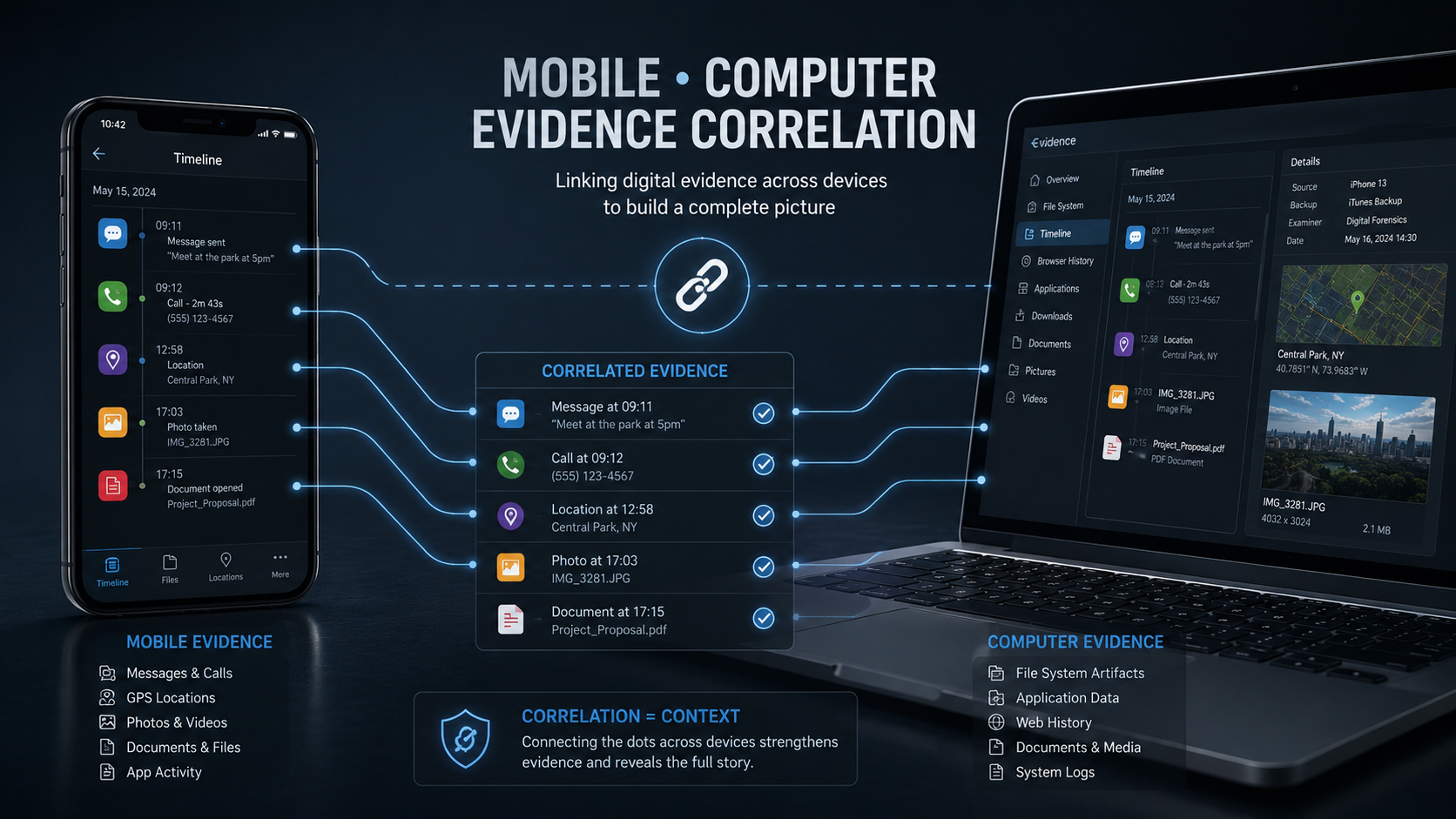
Evidence correlation is the process of connecting related artifacts originating from different evidence sources.
For example, an investigator may need to determine:
- Whether a file found on a laptop was later sent through a mobile messaging application.
- Whether a suspect viewed a document on a computer before sharing it from a smartphone.
- Whether a cloud account synchronized data between multiple devices.
- Whether browser activity on a computer corresponds to actions performed on a mobile device.
The goal is not simply to collect evidence but to reconstruct events across an entire digital ecosystem.
Why traditional workflows struggle
Separate acquisition processes
Historically, computer forensics and mobile forensics evolved as separate disciplines.
Computer forensics and mobile forensics evolved independently. Many laboratories still use separate tools and separate specialists. As evidence volumes increase, investigators often spend more time exporting data and comparing reports than analyzing investigative findings.
Manual correlation usually involves comparing timestamps, identifiers, communication records, cloud artifacts, and file activity across multiple evidence sources. This process is labor-intensive and vulnerable to human error.
Computer investigators focused on:
- Hard drives
- Operating systems
- File systems
- Internet history
- User accounts
Mobile investigators focused on:
- Device acquisition and passcode brute-force
- Call logs
- Messages
- Application data
- Device backups
- SIM card information
Many forensic laboratories adopted separate tools, workflows, and specialists for each domain.
As a result, evidence often ends up stored in different case files, databases, or reporting systems.
Different artifact structures
Correlating data is difficult because artifacts are stored differently across platforms.
Consider a simple communication event:
A message may appear as:
- A SQLite database record on Android
- An application container on iOS
- A synchronized cloud artifact
- A desktop application cache on Windows
Although all artifacts refer to the same activity, they often have different timestamps, identifiers, and metadata structures.
Investigators must manually determine whether these records represent the same event.
Inconsistent timestamp handling
Time normalization remains one of the biggest challenges in digital investigations.
Different systems may store timestamps as:
- Unix time
- Mac Absolute Time
- FILETIME
- Local device time
- UTC timestamps
When evidence originates from multiple devices, investigators must normalize timestamps before accurately reconstructing a timeline.
Even small discrepancies can complicate the reconstruction of user activity.
Massive evidence volumes
Modern investigations routinely involve:
- Multiple smartphones
- Several computers
- Cloud accounts
- External drives
- Messaging platforms
- Social media accounts
A single case may contain millions of artifacts.
While forensic tools excel at data extraction, identifying meaningful relationships among millions of records remains a significant challenge.
Common evidence correlation challenges
| Problem | Cause | Impact | Solution |
|---|---|---|---|
| Separate evidence silos | Different tools | Fragmented investigations | Unified platforms like Belkasoft X |
| Timestamp differences | Different formats | Timeline errors | Normalization |
| Large data volumes | Millions of artifacts | Slow review | Automation and offline AI like BelkaGPT |
| Cross-device activity | Multiple ecosystems | Missed relationships | Correlation analysis |
Why manual correlation does not scale
Traditionally, investigators correlate evidence manually by:
- Reviewing reports.
- Exporting artifacts.
- Building spreadsheets.
- Comparing timestamps.
- Matching identifiers across devices.
This process is labor-intensive and vulnerable to human error.
As evidence volumes continue growing, manual analysis becomes increasingly impractical.
Investigators may overlook relationships that are hidden across multiple evidence sources simply because finding them requires reviewing too much data.
The challenge of linking mobile and computer evidence
The most valuable investigative findings often emerge when evidence from multiple devices is viewed together.
Consider a scenario:
- A document is created on a laptop
- The file is uploaded to cloud storage
- The same file is downloaded on a smartphone
- The document is shared through a messaging application
Each step may generate artifacts on different systems. Analyzing devices independently may reveal only fragments of the story.
Only cross-device correlation allows investigators to reconstruct the complete sequence of events.
Why many forensic tools still operate in silos
Many digital forensics platforms were originally designed for a single evidence domain.
Some tools specialize in:
- Computer forensics (for example, EnCase)
- Mobile forensics (for example, UFED)
- Cloud forensics
- Network forensics
Although these tools may perform exceptionally well within their specialty, investigators often need additional steps to correlate findings across domains.
This can result in:
- Duplicate work
- Multiple databases
- Fragmented reporting
- Increased training requirements
- Longer investigation timelines
The challenge becomes particularly significant for agencies facing limited personnel and increasing caseloads.
The shift toward unified forensic platforms
To address these challenges, forensic software vendors have increasingly moved toward unified investigation platforms like Belkasoft X.
Rather than treating computer, mobile, and cloud evidence as separate disciplines, modern platforms attempt to place all evidence into a common analytical environment.
This approach allows investigators to:
- Search across all evidence sources simultaneously
- Build unified timelines
- Identify relationships automatically
- Reduce context switching between tools
- Generate consolidated reports
The objective is to help investigators focus on investigative conclusions rather than technical data management.
The role of AI in evidence correlation
Artificial intelligence is becoming an important component of modern digital investigations.
AI systems can assist investigators by:
- Identifying relationships across datasets
- Detecting patterns in communications
- Summarizing large evidence collections
- Highlighting potentially relevant artifacts
- Accelerating review workflows
Importantly, AI does not replace forensic validation. Instead, it helps investigators navigate large evidence volumes more efficiently.
As digital evidence continues to grow, AI-assisted analysis is increasingly viewed as a practical necessity rather than a future capability.
How Belkasoft approaches cross-device investigations
Modern forensic platforms increasingly emphasize evidence correlation across multiple data sources.
One example is Belkasoft’s integrated forensic ecosystem.
Belkasoft X provides a unified forensic environment capable of processing computer, mobile, cloud, memory, vehicle, and drone evidence within a single case. This reduces the need to move between multiple investigative platforms.
BelkaGPT adds AI-assisted investigative workflows that help investigators search, summarize, and analyze large evidence collections using natural-language interactions.
Together, these approaches reflect a broader industry trend toward integrated investigations rather than isolated evidence processing.
Belkasoft X
Belkasoft X is designed to process multiple evidence types within a unified environment, including:
- Computers
- Mobile devices
- Cloud data
- Memory captures
- Drone data
- Vehicle data
Instead of separating evidence by acquisition source, investigators can analyze findings within a single case and build relationships between artifacts originating from different devices.
This approach can simplify investigations where activities span computers, smartphones, and cloud services.
BelkaGPT
BelkaGPT extends this concept through AI-assisted forensic analysis.
The technology helps investigators interact with large evidence collections using natural language queries and automated analytical workflows.
Rather than manually reviewing millions of records, investigators can focus on answering investigative questions while the system assists in locating relevant information.
As AI capabilities mature, tools such as BelkaGPT represent an emerging trend toward more intelligent evidence correlation and case analysis.
What law enforcement agencies need from modern forensic software
As digital ecosystems become more interconnected, effective investigations increasingly depend on the ability to correlate evidence across multiple sources.
Key capabilities include:
- Unified evidence processing
- Cross-device artifact correlation
- Timeline reconstruction
- Cloud integration
- AI-assisted analysis
- Scalable case management
The agencies that can efficiently connect evidence across devices are often better positioned to uncover critical investigative findings.
Frequently Asked Questions
Why is it difficult to correlate mobile and computer evidence?
Mobile and computer systems store data differently, use different timestamp formats, and generate separate artifact structures. Investigators must identify relationships between these records to reconstruct events accurately.
What is evidence correlation in digital forensics?
Evidence correlation is the process of connecting related artifacts from multiple evidence sources to establish a coherent sequence of events.
Why does manual correlation take so long?
Modern investigations may contain millions of artifacts across multiple devices and cloud services. Manually reviewing and comparing records is time-consuming and prone to human error.
Can AI help correlate digital evidence?
Yes. AI can assist investigators by identifying patterns, relationships, and relevant artifacts across large datasets, helping reduce review time and improve efficiency.
How does Belkasoft support evidence correlation?
Belkasoft X provides a unified environment for analyzing computer, mobile, cloud, and other evidence sources, while BelkaGPT adds AI-assisted analysis capabilities that help investigators navigate large evidence collections more efficiently.
Key takeaways
- Most investigations involve multiple devices
- Evidence correlation is often more difficult than evidence extraction
- Timestamp normalization remains a major challenge
- Manual correlation does not scale well
- AI and unified forensic platforms improve efficiency
Conclusion
Police agencies increasingly face investigations involving multiple devices, cloud services, and vast amounts of digital evidence. While extracting data is no longer the primary challenge, correlating information across computers, smartphones, and cloud platforms remains difficult.
The industry is gradually moving from isolated forensic workflows toward unified platforms and AI-assisted analysis. Solutions such as Belkasoft X and BelkaGPT illustrate this broader trend by helping investigators analyze evidence within a single investigative context and uncover relationships that might otherwise remain hidden.
As digital ecosystems become more interconnected, correlating evidence across computers, smartphones, cloud services, and applications becomes increasingly important. Agencies and private labs that can efficiently connect evidence across sources are better positioned to reconstruct events and uncover investigative insights. Unified forensic platforms and AI-assisted analysis are becoming key technologies for addressing this challenge.

